Frequently asked questions (FAQ)
Answers to the most common questions about aptitude tests, our platform, plans and payment. If yours is not here, email us at support@aptitude-tests.co.uk.
52 answers in eight topics, last checked on 17 October 2026.
Aptitude tests
What the tests are, why employers set them and how they are scored.
An aptitude test is a timed, standardised test that employers use to compare job applicants. It measures how you work with numbers, written information, patterns or situations at work, not what you know about a subject.
Most are taken online, soon after you apply. They are also called psychometric, reasoning or ability tests.
Large employers receive many more applications than they can interview. A test gives every applicant the same questions under the same conditions, so the results can be compared.
The recruiter then decides who goes on to the next stage, usually an interview or an assessment centre.
The most common are numerical, verbal and logical reasoning tests. Situational judgement tests ask how you would handle problems at work, and mechanical reasoning tests are set for technical roles.
Personality questionnaires are often sent with them.
- Numerical TestsTables, charts and percentages
- Verbal TestsPassages and statements
- Logical TestsSeries, grids and blocks
- Inductive TestsRows and odd ones out
- Diagrammatic TestsFigures changed by a rule
- Situational Judgement TestsWorkplace scenarios
- Mechanical TestsGears, levers and circuits
- Personality QuestionnairesBig Five and trait questionnaires


Most employers do not write their own tests. They buy them from test publishers such as SHL, Kenexa, Talent Q and Cubiks, and each publisher has its own format: the number of questions, the time limit and the rules all differ.
SHL, Kenexa, Talent Q and Cubiks are trademarks of their owners, who are not connected with this site.
Your score is compared with a group of people who took the same test, and the result is given as a percentile. The 72nd percentile means you scored higher than 72 in every 100 of that group.
Each employer sets its own pass mark, and most do not publish it.
Take practice tests of the kinds your invitation names. Sit the first one without the timer and read the solution to each question, including the ones you got right.
Then switch the timer on and take as many different tests as you can, changing the settings as you go: with and without question skips, and with negative marking. After each test, open the report and go back through the questions you missed.
Yes, in almost every online numerical test, and our practice tests assume you have one. Use the calculator you will have on the day, so that its keys are familiar.
At an assessment centre the employer usually hands you a basic one.
Types of test
A short answer for each kind of test, with a link to its full guide.
A numerical reasoning test checks how well you reason with numbers. Each question shows a table or a chart and asks you to find or work out an answer from it.
The maths is school level: percentages, ratios, averages and currency conversion. The hard part is the time limit: about a minute for each question.
A verbal reasoning test checks how well you understand written information. You read a short passage and decide whether a statement about it is true, false or impossible to say from the passage alone.
Some publishers ask multiple-choice questions about the passage instead. In both forms only what the passage says counts, not what you already know.
A logical reasoning test checks how well you find a rule and apply it. Each question is a set of shapes that follow a hidden rule, and you choose the figure that comes next or fills the gap.
There are no words or numbers to work with. Publishers also call tests of this kind inductive, abstract or diagrammatic reasoning.
An inductive reasoning test asks you to work out a rule from a few examples. You are shown figures that follow the rule, and you decide which figure comes next or which one breaks it.
Our inductive tests are part of the Logical Tests package.
A diagrammatic reasoning test shows you one figure changed into another and asks you to make the same change to a third. The changes are simple ones, such as a turn, a mirror image or a change of shade, and a question often combines two.
Our diagrammatic tests are part of the Logical Tests package.
A situational judgement test describes problems you could meet at work and asks how you would handle them. Each question is a short scenario with four or five possible responses.
You choose the most effective response, the most and the least effective, or put them in order. Your answers are marked against a key agreed with people who know the job.
A mechanical reasoning test checks how well you understand the way physical things work. Each question is about a picture, such as a set of gears, a lever, a pulley or a circuit, and has a few answers to choose from.
It is set for technical roles: apprentices, technicians and engineers. The principles come from school physics.
A personality questionnaire asks how you usually think, feel and behave at work. You rate statements about yourself, or choose the one most like you and the one least like you.
No answer is right or wrong, and there is nothing to work out. Employers use it to see how you are likely to go about the job.
Practice tests and the platform
How a practice test works, from its settings to its solutions.
59 practice tests in six packages: numerical, verbal, logical, situational judgement, mechanical and personality. Before each test you choose how to sit it: timed or untimed, with or without question skips, negative marking and solutions.
After each test you get a report with your score, your accuracy and your percentile, and you can go back through every question in review mode.
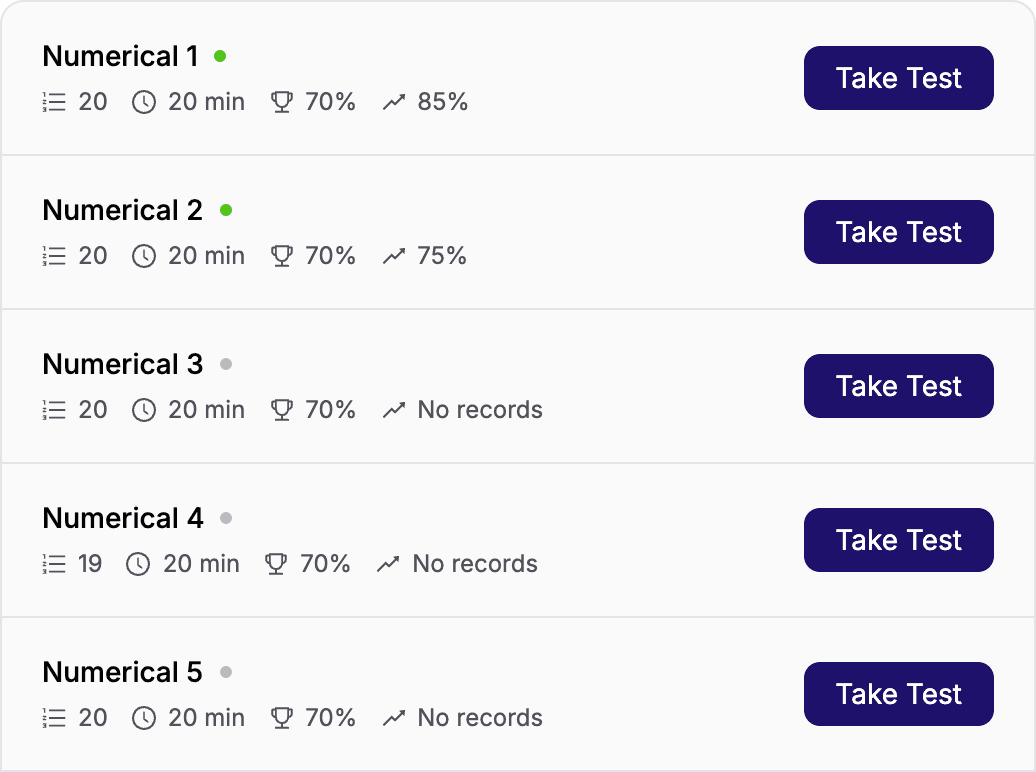
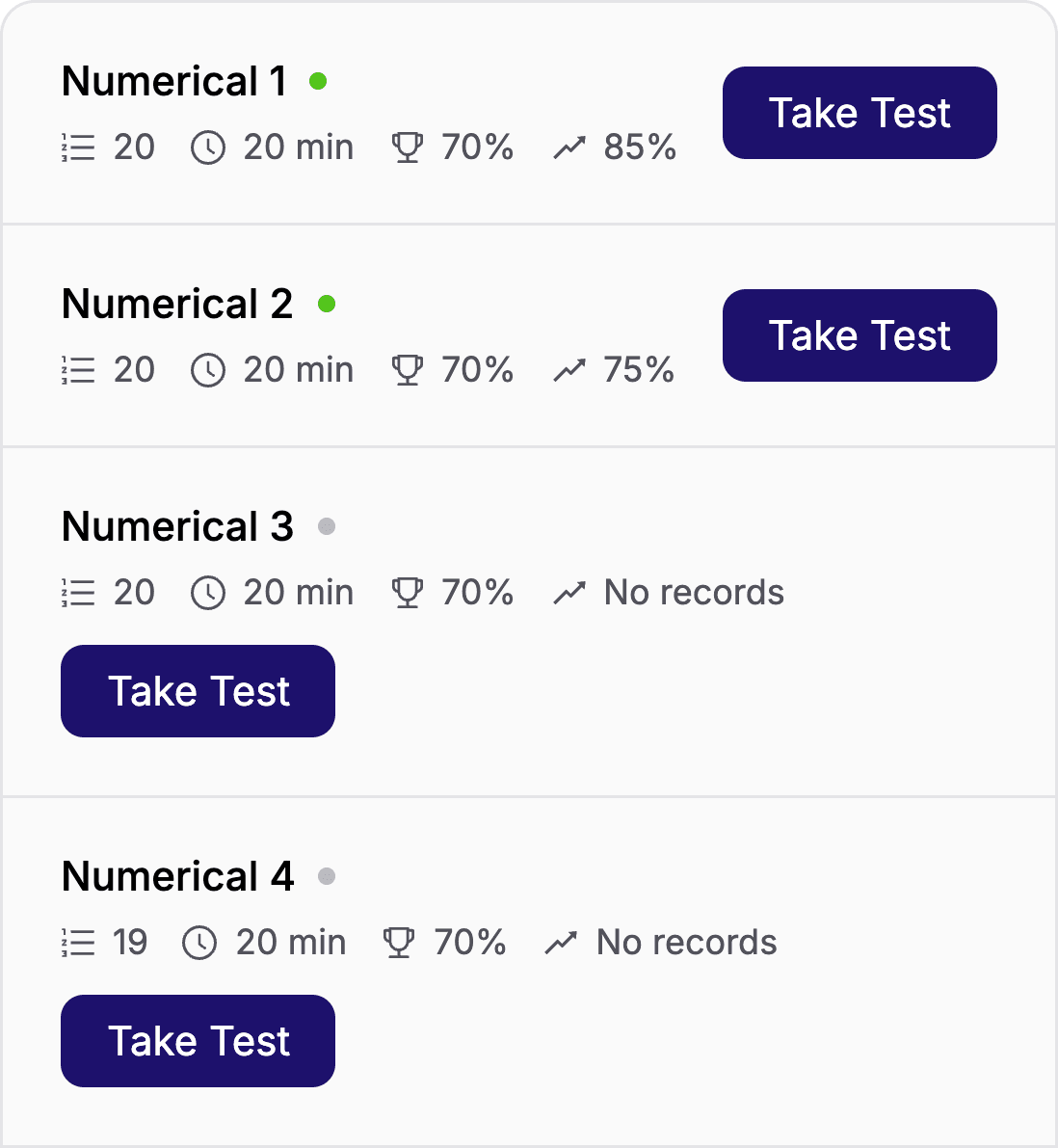
They are the same kinds of test, in the style of the main publishers: the same types of question, set against a time limit. They are not the publishers' own questions, and no employer's real test is on this site.
The questions you meet on the day will be different. Practice teaches you the method and the pace of each kind of test.
We have a page for each of more than 80 employers. It says how the employer hires and which tests to expect, and lists the practice tests for them.
The practice tests are the same on every employer's page: an employer's name does not change which tests you get.
Four, on the test's start page:
Timed Test runs the clock. When the time is up, the test is handed in with the answers you have given.
Show Solutions shows the solution under each question as you go.
Allow Question Skip lets you move between questions. With it off, you answer each question before you see the next, and you cannot go back.
Negative Marking takes marks off for wrong answers.
A test starts timed, with question skips allowed and the other two off.

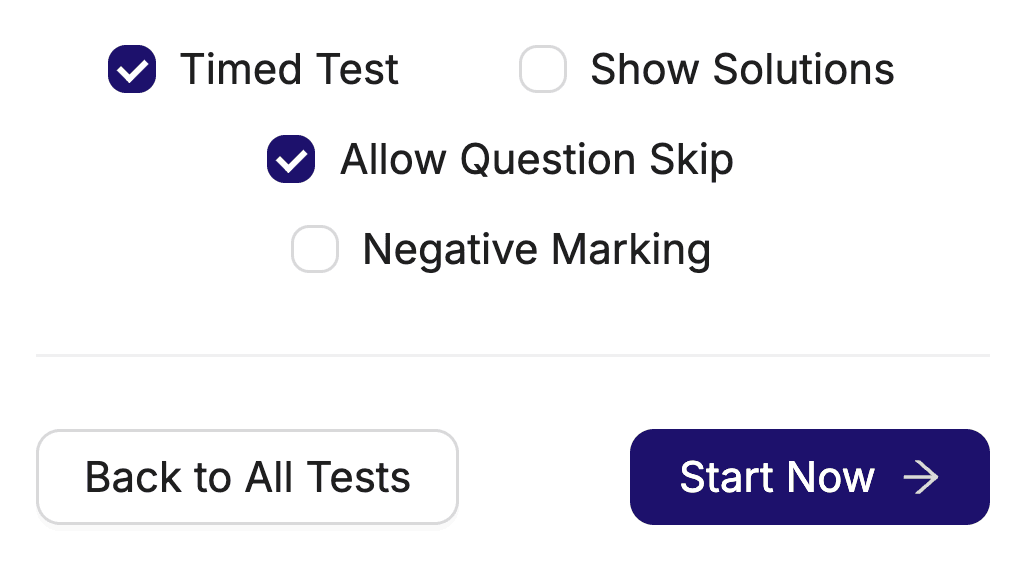
Yes, as often as you like while your access lasts. Open the test from your list again and press Start Now.
Each attempt is saved, and after a few attempts the report charts your earlier scores for that test.
The attempt is lost. A test is saved only when you hand it in, so closing or reloading the page means starting it again. Try to sit each test in one go.
If your connection drops as you hand it in, you are asked to try again.
Yes. The platform runs in the browser on a phone, a tablet or a computer, and there is nothing to install.
Tables and charts are easier to read on a larger screen, so a laptop is the better choice for numerical tests.
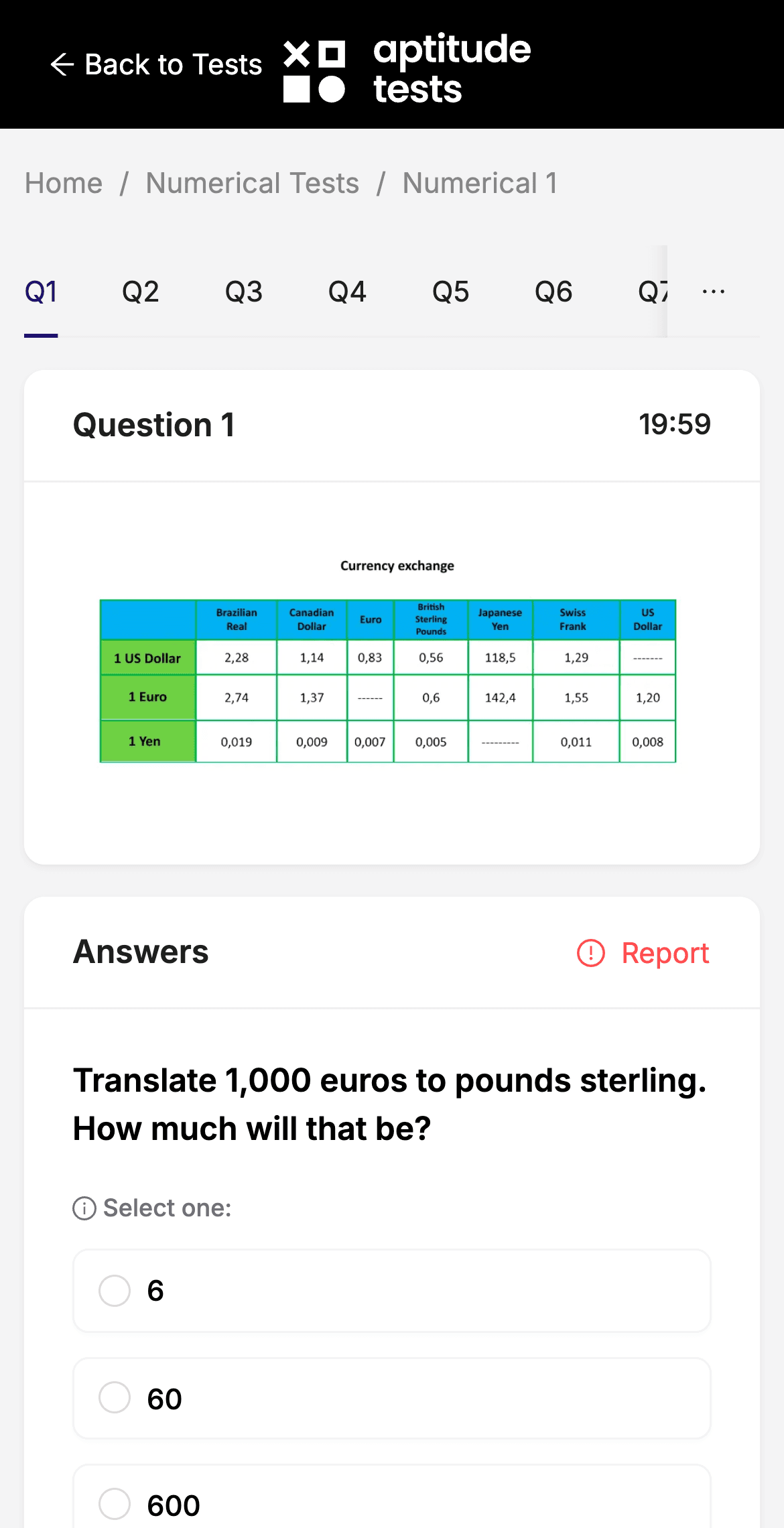
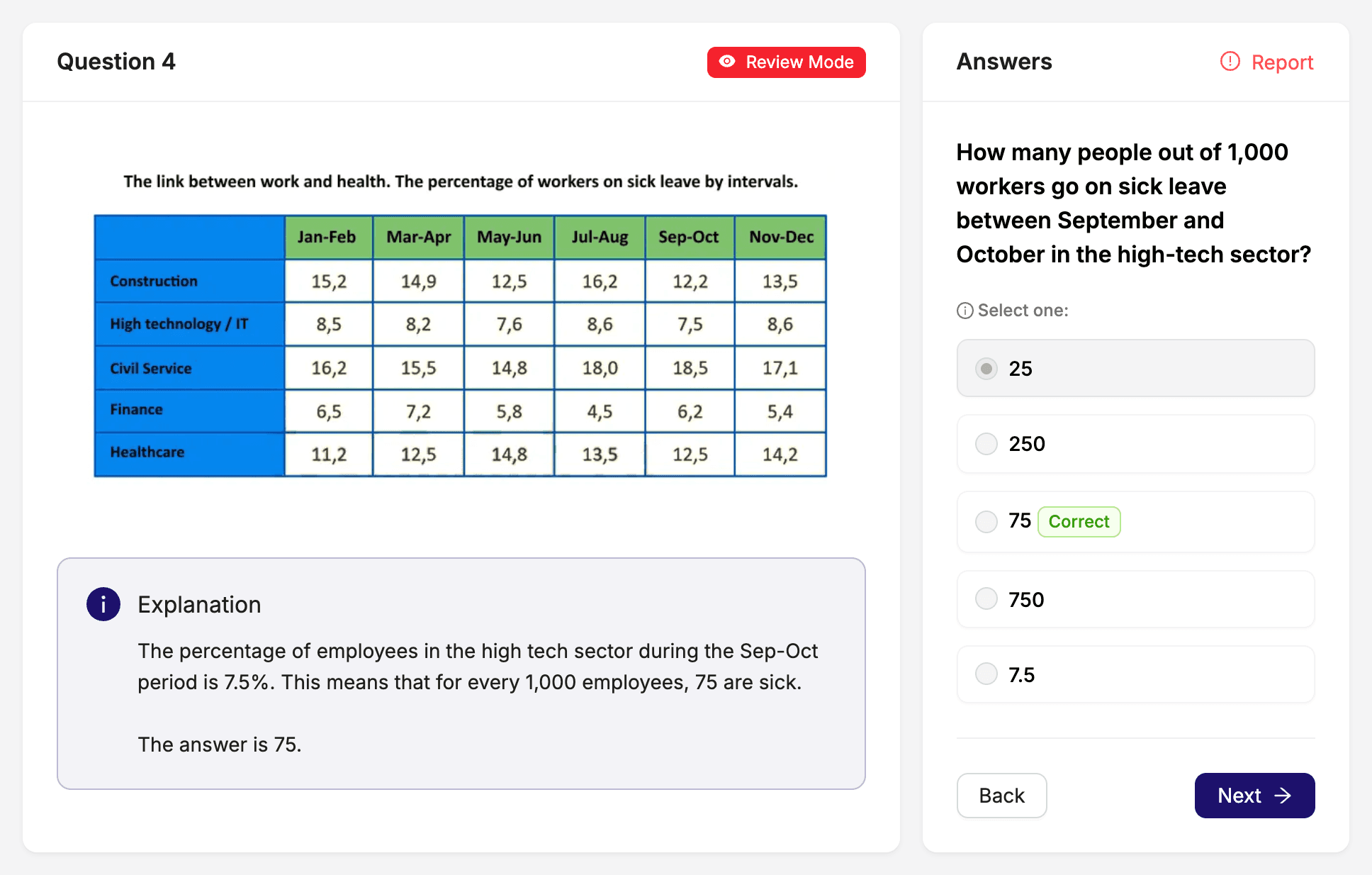
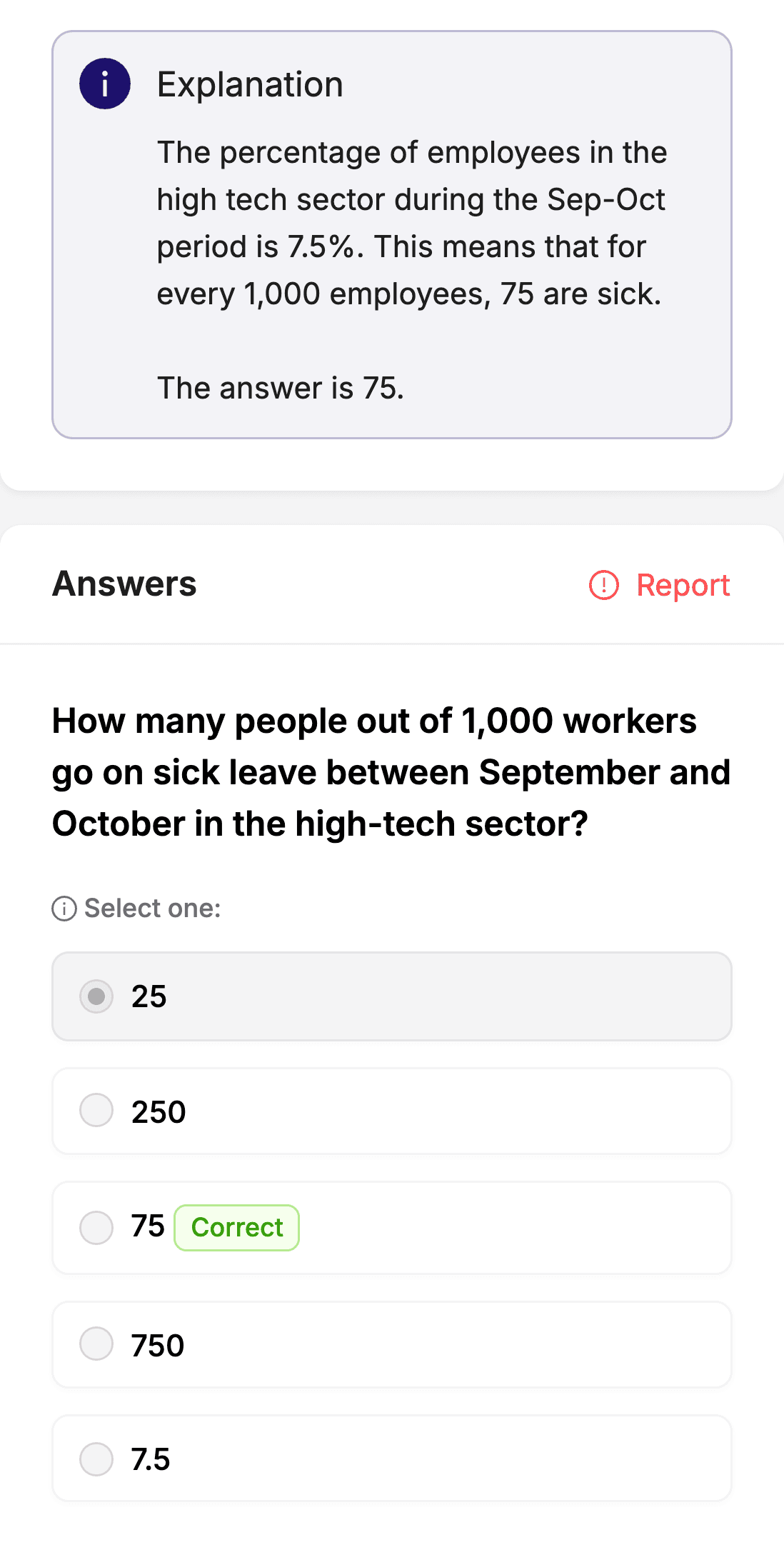
Yes. Solutions are written out step by step. You can read them as you go, with Show Solutions switched on, or keep them for the end.
After a test, review mode takes you back through each question with your answer, the correct answer and the solution. Start it from the report.
Free tests and plans
What is free, what the plans cost and how long access lasts.
Yes. 11 tests are free, with a sample from every package. They have the same settings, solutions and report as the paid tests.
No. The free tests need no registration and no card details. A paid plan comes with an account, where your packages, your tests and your results are kept.
One package costs £9.99. All-in-One, which is all six packages, costs £29.99. Each gives 3 months unlimited access, no auto-renew.
Check your invitation email: it names the tests you will sit. If it names one kind of test, the package for that kind is enough.
If it names several, or you do not know yet, All-in-One has all six packages and costs less than four bought one by one. If you are still not sure, email us the employer and the role, and we will suggest a package.
No. You pay once for 3 months unlimited access, no auto-renew. There is no subscription to cancel.
Access lasts 3 months from the moment you pay. The end date is shown on the Membership page of your account and above each package's list of tests.
When it ends, the tests lock again. Your account and your past reports stay, and you can buy access again at any time.
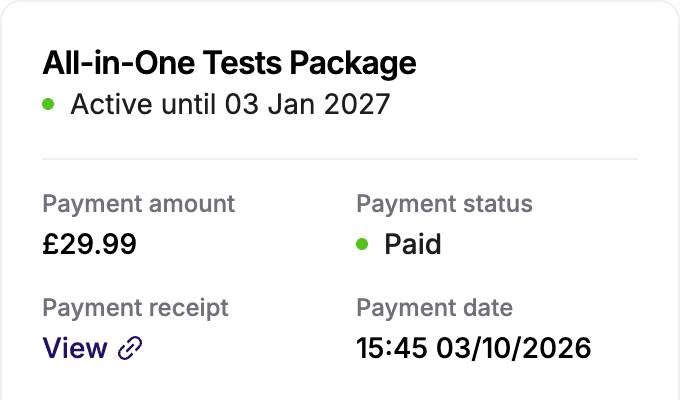
Yes. Each purchase is separate and has its own 3 months. Packages you have not bought show an Upgrade button on your dashboard.
Yes. Universities, colleges and careers services can buy access for groups of students at a lower price. Email us the number of students and the packages you need.
Buying and payment
How to buy a package, how to pay and where to find your receipt.
Step 1: Choose a plan on the pricing page, on a test page or on a company's page, and press Buy now.
Step 2: Sign in, or register with your name, email and a password: we email you a code to confirm the address. You can also use your Google account.
Step 3: Pay on the secure payment page. You come back to a confirmation page and your tests are unlocked.
Visa, Mastercard and American Express cards, Apple Pay and Google Pay. Payments are taken by Stripe, in pounds sterling.
If your card is in another currency, your bank converts the amount.

Yes. The payment page is run by Stripe, and your card details go straight to it. We do not see or store your card number.
Press See Tests on the confirmation page. Your dashboard opens: choose a package, pick a test and press Take Test. You can start straight away.
Later, press Sign in at the top of this site to get back to your tests.
On the Payments page of your account: each paid payment has a Receipt button. The confirmation page you see after paying has a View Receipt button.
On the payment page. Press Add promotion code there and enter it: the total changes before you pay.
Do not pay again. Email us from the address of your account and we will unlock your tests.
If you left the payment page before paying, the order is on the Payments page of your account with a Pay Now button, which takes you back to it while that payment page is still open, for about a day. After that, start a new order.
Your account
Signing in, changing your details and deleting your account.
Press Sign in at the top of this site. Use the email and password you registered with, or Sign In with Google if that is how you created the account.
On the sign-in page, press Forgot Password and enter the email address of your account. We email you a 6-digit code: enter it within 10 minutes, then choose a new password. If you created the account with Google, there is no password: use Sign In with Google.
You can change your name and your password on the Profile page of your account. The email address cannot be changed there: email us if you need to move the account to another address.
Open the Profile page, press Delete Profile and confirm. Your account, your results and your payment history are deleted permanently, and this cannot be undone. A record of each payment is kept for six years, as tax law requires.
Yes. Sign in on any computer, tablet or phone: your packages and results are kept in your account, not on the device.
Results and reports
What your report shows and how to read it.
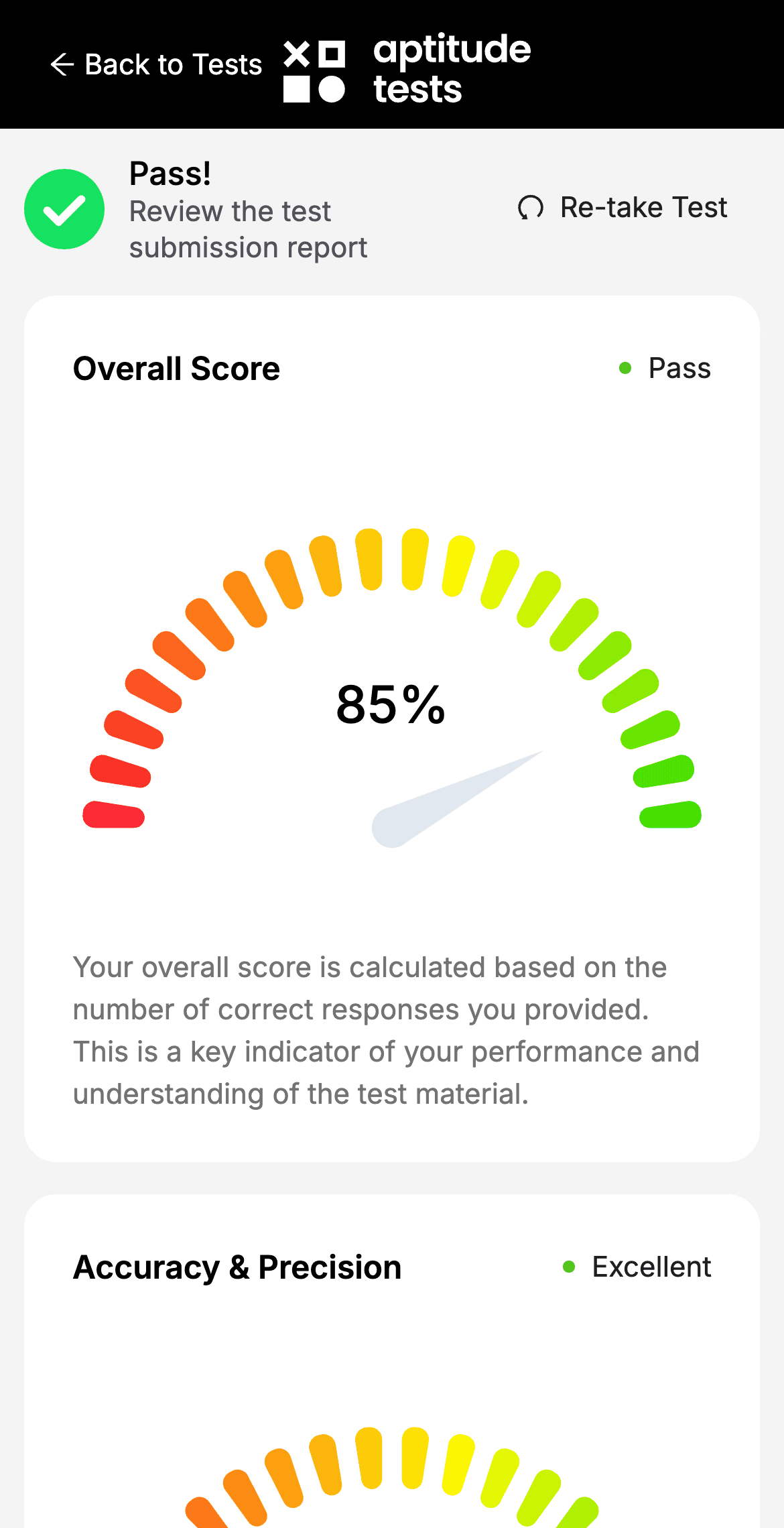
It opens with Pass or Fail, measured against the test's pass score, and three gauges: your overall score, your accuracy and your percentile.
Under them are the questions you answered correctly, the questions you skipped, the time you spent and your average time per question. Then every question is listed, marked right or wrong.
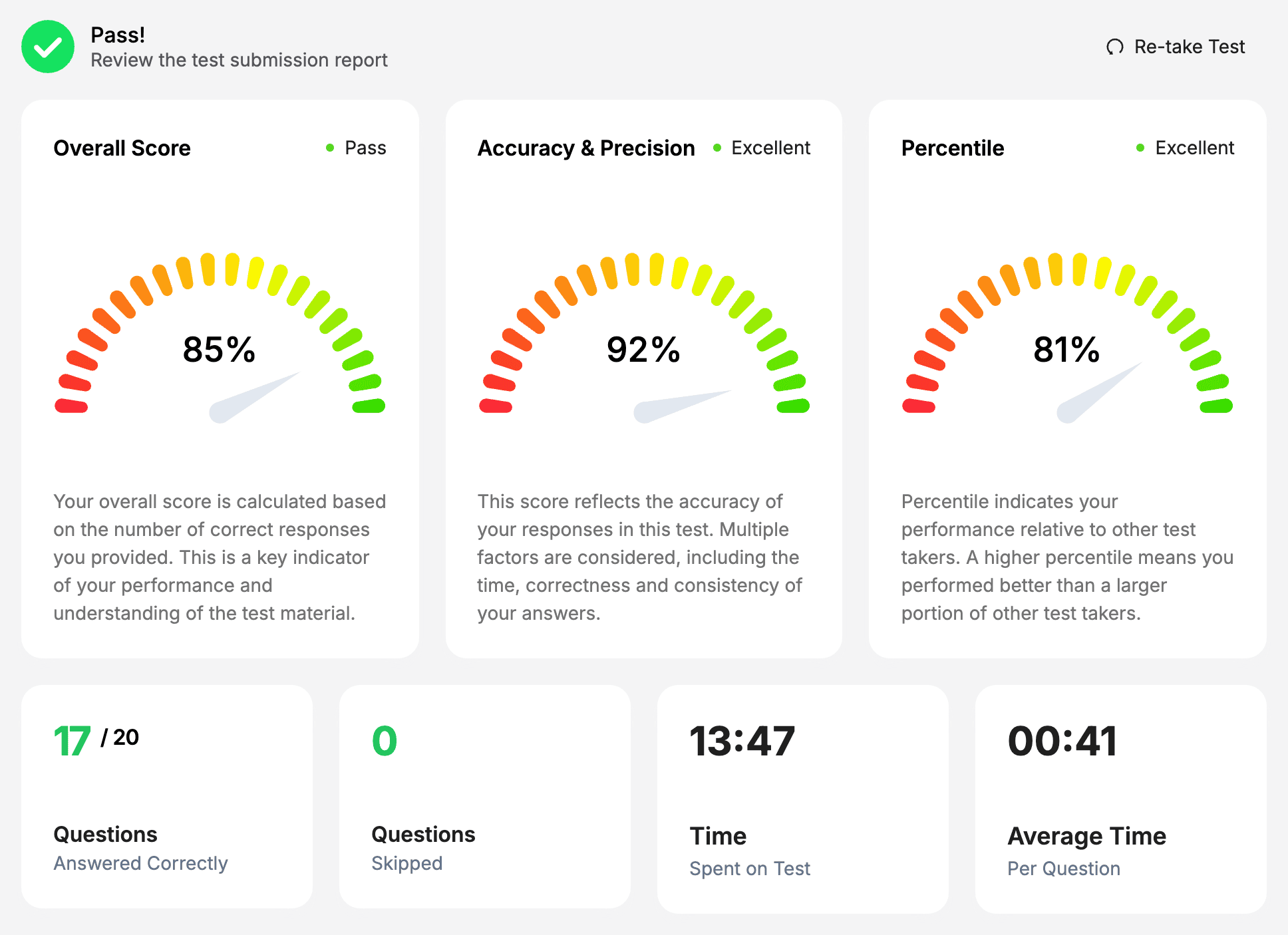
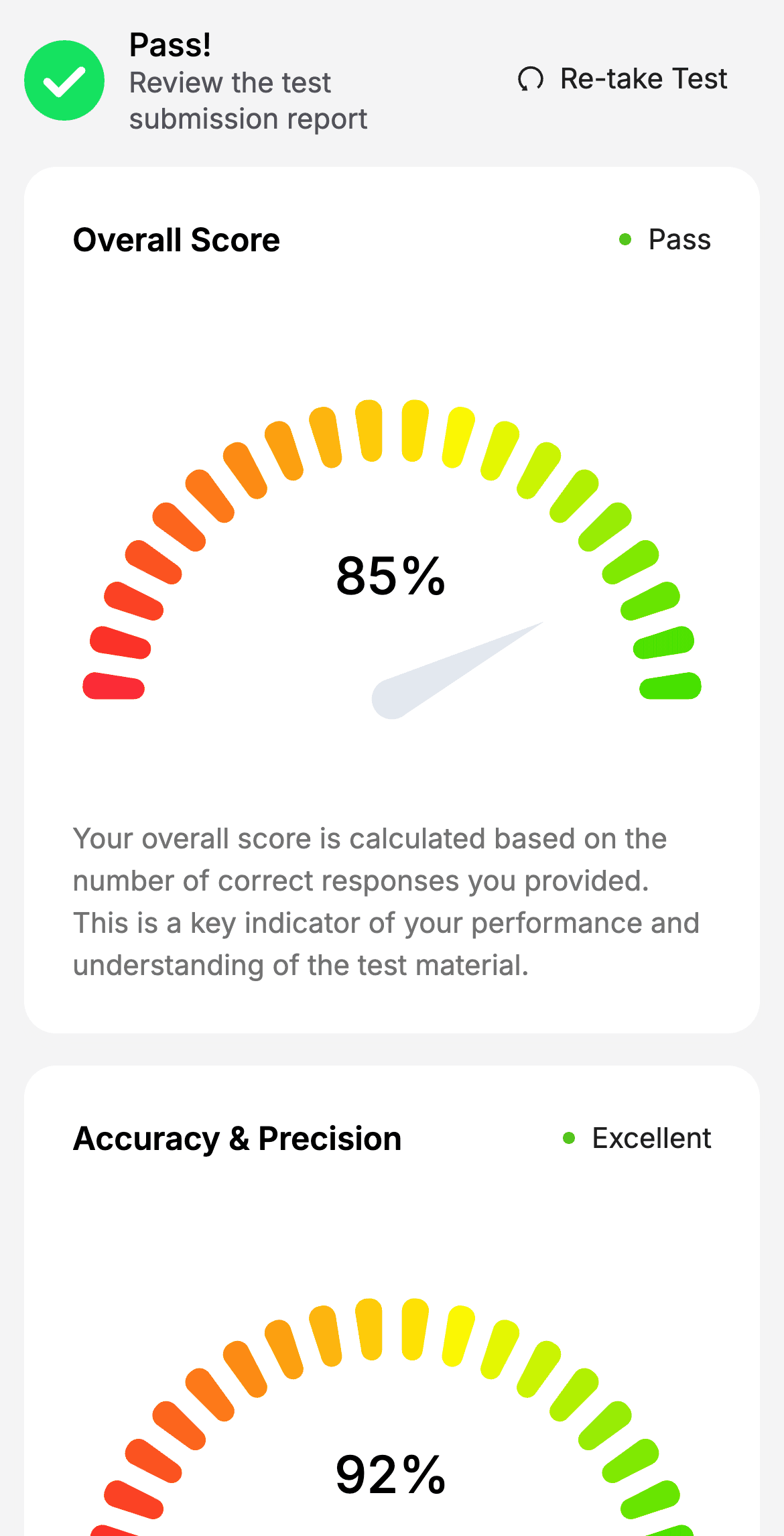
Your score is ranked against recent results from other people who took the same test on this site.
It is an estimate: an employer compares you with its own group of candidates.
It combines your correct answers, the time you used and the questions you skipped. Rushing or skipping lowers it.
Each reasoning test has a pass score, shown on its start page and in the list of tests. Reach it and the report says Pass.
It is a target for practice, not an employer's pass mark.
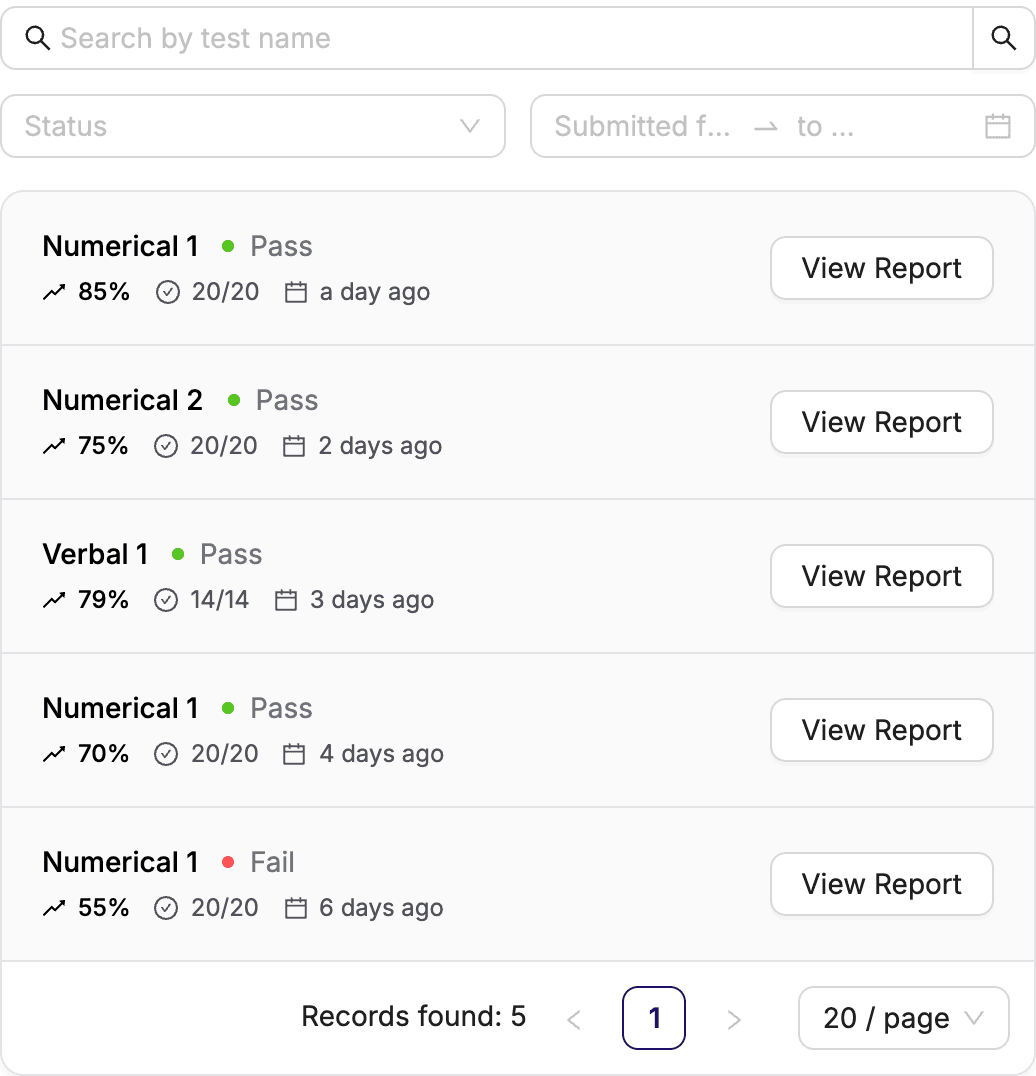
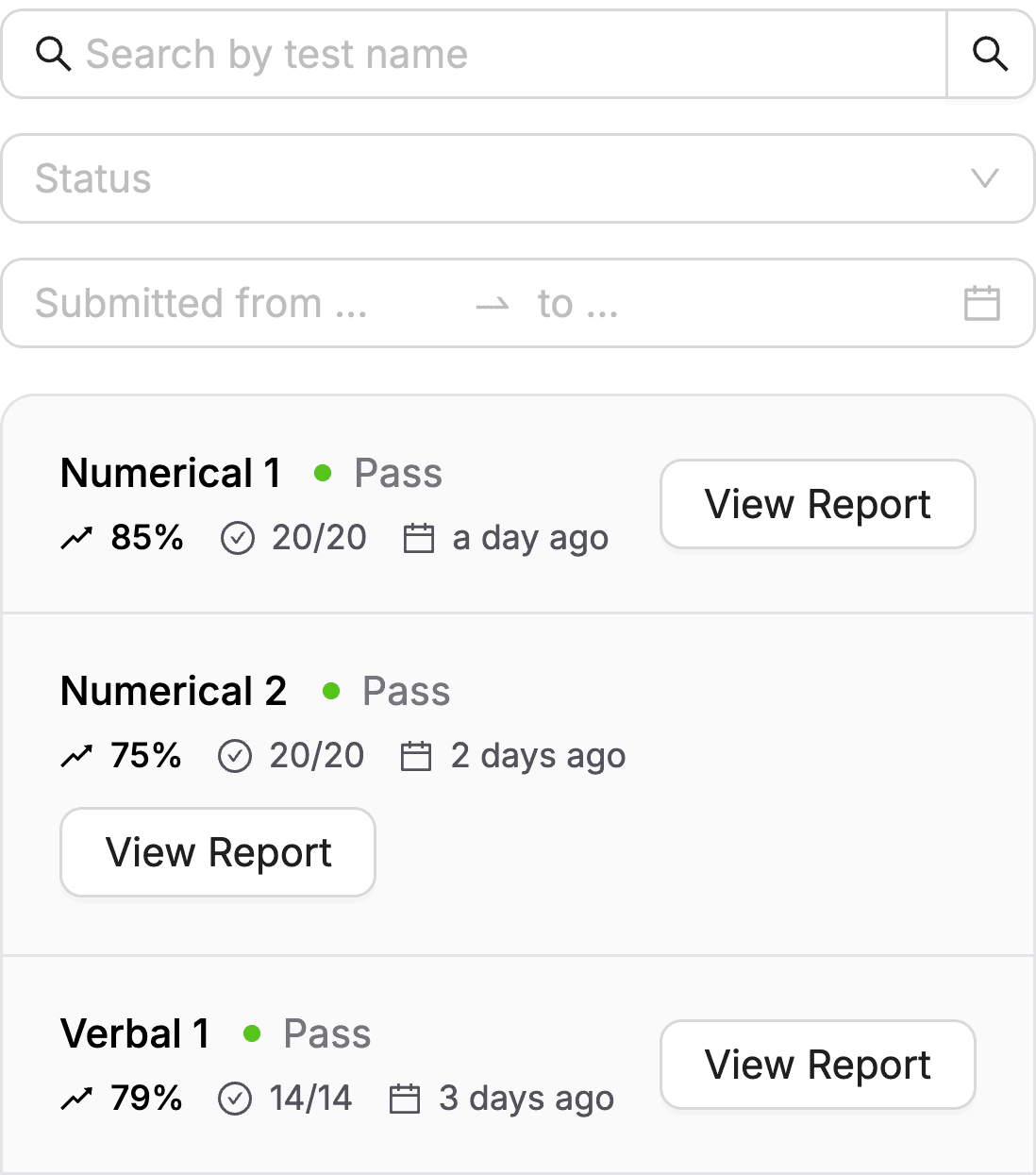
Open Tests results in your account. Every attempt is listed with its score and date, and View Report opens the full report. You can search by test name and filter by pass, fail or date.
A profile of your traits. Each trait the questionnaire measures is placed on a scale from 0 to 10, with a description of what the lower and the higher end mean. There is no pass or fail, and you can print the report.
Refunds and support
The money-back guarantee, mistakes in questions and how to reach us.
Yes. Every paid plan has a 14-day money-back guarantee. Email us within 14 days of buying and say what went wrong, and once the request is approved we refund the payment to the card or account you paid with.
The guarantee has conditions, including a limit on the number of tests you have started, so please read the terms.
Report it from the question itself:
Step 1: Press Report at the top of the Answers panel.
Step 2: Choose the type of error and where it is: the question, its answers, its explanation, the whole test or the results page.
Step 3: Add any details and press Submit Report.
You can also email us.
Email support@aptitude-tests.co.uk. We reply within one business day.
If your question is about a payment or a test, write from the address of your account and name the test, so we can find it.
Still have a question?
If the answer is not on this page, email us.
Our address is support@aptitude-tests.co.uk